Musik Matters
Listening to, understanding and playing tango music for friends.
Listening & Understanding
Curating & DJing
Tanda, Cortina, Grouping: Assembling a Tanda
How elements come together for a Tanda: orchestra, singer, era, and mood – with a simple rule for suitable groupings.
FYI: what software we Münster DJs use
From streaming and quality transfers to the tools used by Münster DJs: finding, preparing, and reliably playing music.
Und jetzt bist du dran! Deine ersten Tandas...
Die wichtigsten Gruppierungen von D’Arienzo, Di Sarli, Troilo und Pugliese – und passende Tandas zum Mixen.
From the Blog
Your First D'Arienzos
How Juan D'Arienzo saved tango in 1935: history, musical examples, and dance videos on the “King of Rhythm” – for everyone who dances tango and wants to get to know the orchestras.
I found the new "Mimosa"!
Piowpiiaowpow, that's how they all sound, the Hawaiian guitar tangos of Canaro. But at a 107 at last count, it takes a while to go through them. I found one that was new to me! Help me spread the word
Hit the Keys, Polito!!
Who is Polito and why do I think he's so cool? Read the description of my chosen hero of Tango Metal and D'Arienzo's most powerful pianist during their collaboration in 1938-1939.
Erstes Mal Tangomusik auflegen, geschafft ✔️ – ein Tagebucheintrag
Mein erstes Mal als Tango-DJ in Münster: viel Vorbereitung, Technikzweifel, Projektionen mit Songtexten und die Frage, wem wir beim Auflegen eigentlich dienen.
Do you want to learn a partner dance? Why Tango is the best choice
Why Argentine Tango uniquely combines improvisation, connection, empathy, posture, health, music, and personal expression.
Gricel, Part 1: The Love Story
José Maria Contursi, son of the poet of "Mi Noche Triste," finds his muse for glorious poetry in a young model from the countryside… and manages to keep his inspiration a secret.
What's the difference between Argentine and Standard Tango?
World Heritage, music, poetry, embrace, steps, styles – how Tango Rioplatense and Standard Tango truly differ.
"Tango in Ruins" - Prologue
July 1946, inter-zonal border: An Argentinian violinist, a stolen violin, a customs officer who wants to hear Gardel – and something under the green velvet that nobody should find. A prologue
How Finland Invented Argentina's National Dance
The hidden Nordic origins of tango — from Finnish sauna rituals and Viking longships to a rune stone in Maldonado. A historical reconstruction.
The surprising flood of football Tangos, and Reinaldo Yiso the Football Poet
How many Tangos are actually about football? An astonishing number. A collection with translations for download – plus a portrait of the poet Reinaldo Yiso.
1935–1946: Why the best Tango music comes from the “Golden Decade”
Why the music that fills the dance floor comes from a surprisingly narrow timeframe.
Machine-translated from German.
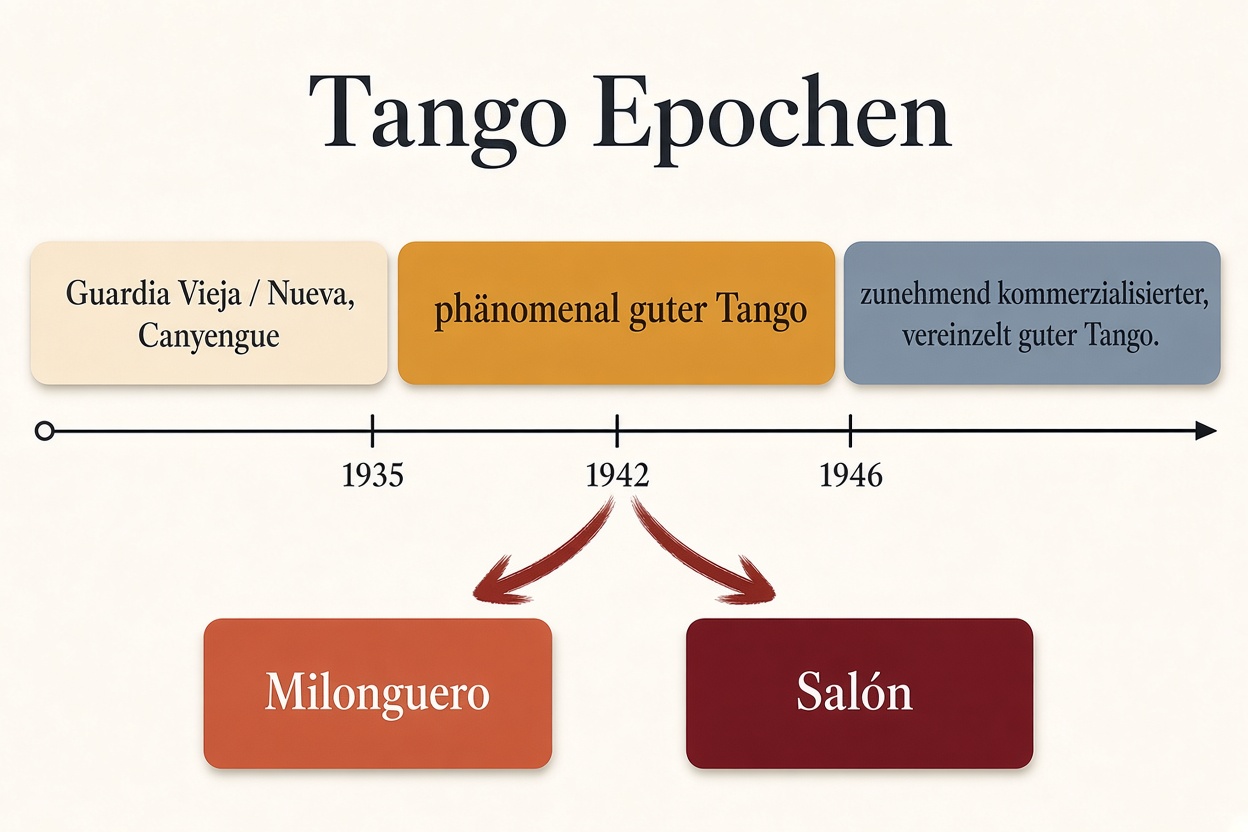
Anyone who’s been dancing Tango for a while, regularly attends Milongas, and has survived their rebellious “non-Tango” youth phase, usually acquires a taste for it quite naturally: the music that fills the dance floor and keeps couples dancing non-stop usually originates from a surprisingly narrow timeframe. Roughly speaking, from the years between 1935 and 1946. This is no coincidence, nor is it nostalgia. In those good ten years, everything came together in Buenos Aires that we Tangueros and Tangueras need for dancing. Before this period, the full recipe wasn't yet known, and afterwards, it was used for other purposes.
Before: Tango “Soft”
The late 1920s are by no means musically weak; quite the opposite. It’s the era of the sextets: two Bandoneons, two violins, piano, and double bass. Arrangements are scarce. Six musicians who know each other play from simple notes, and everyone knows what to do. This often sounds charming, sometimes beautiful, but for the dance floor, something is usually missing. And many pieces are actually songs: the melody is “sung” long, soft, and legato, even if no one is singing. A clear, carrying beat that couples can stand and walk to is often sought in vain – one might say there’s a lack of conviction, even aggression. Not just the beat, but the whole personality of this music still has something “innocent” about it.
Added to this was a double blow around 1930. The Great Depression hit Argentina, and at the same time, sound films displaced cinema orchestras, which had secured a steady income for many Tango musicians. Many orchestras lost their contracts and disbanded, especially those that played more sophisticated music. What remained and ended up on records between 1932 and 1935 was primarily what sold. Francisco Canaro’s music dominated the scene with stage shows and hits.
And then another style dominated: the “Tango Canción”. This music had existed since 1917 alongside dance music as sung Tango, not intended for dancing. The absolute star of the genre was Carlos Gardel, and alongside him, great voices like Ignacio Corsini, as well as many magnificent female singers like Ada Falcón or Libertad Lamarque, performed in theatres and on the radio, not in dance halls.
1935: A Death and a Beginning
In June 1935, Gardel died in a plane crash in Colombia. All of Argentina was in shock. For months, there was debate about who “the next Gardel” might be, but no one was. Into this void stepped something completely different.
Just a few days after Gardel's death, Juan D'Arienzo recorded his first records with his new orchestra. By the end of the year, Rodolfo Biagi joined on piano, and with that, something began that had not existed before: a hard, clear, driving rhythm, played for people who wanted to dance. By 1937, D'Arienzo was truly successful, and in the same year, Laurenz recorded his “Arrabalero”. This launched the two main strands that would define the coming decade: the rhythmic and the melodic-lyrical.
1935–1946: Why these specific years?
Because music was played for dancers. Hundreds of thousands of people went dancing every weekend, in clubs, halls, and community venues. The orchestras played live for an audience that wanted to move. And they immediately noticed what worked and what didn't. This direct feedback from the dance floor is embedded in every recording from this period. Many Milongas were improvised and never recorded back then, as the band simply played them for the dancers.
Because there was money. This ensured both quantity and quality. During the Second World War, Argentina profited from its exports. People had money in their pockets and could go out, and the orchestras thrived on this. Sextets grew into large orchestras with four Bandoneons, four violins, and more. There was enough work for dozens of bands simultaneously, and competition was correspondingly fierce. Everyone had to find their own style to get booked.
Because diversity exploded. In no other era were there so many distinctive orchestras alongside each other: D'Arienzo with his beat, Di Sarli with his singing melodies and his powerful Arrastre, Troilo with his poetry, Pugliese, Laurenz, Caló, Tanturi, Rodríguez, D'Agostino, Fresedo, Biagi, De Angelis, and many more. And they all made music you could dance to, each in their own way. For us DJs, this is a gift: you can play a varied set all night long without ever losing the danceability – and all of it from this golden age.
Because the balance was right. The music became richer and richer during these years: better arrangements, great singers who blended into the orchestra rather than standing apart from it, refined harmonies. But it always stayed grounded. The beat, which dancers could hold onto, was always there. Often, a walking bass underpinned it, and that specifically gave the melody above it the freedom to play. Enough complexity to surprise you even on the twentieth listen, and enough simplicity to understand it with your body. This delicate balance existed neither before nor after.
Because new Tangos came like confetti. In the 30s and early 40s, so many new pieces were written that Argentinians themselves said they fell “like confetti”. Orchestras constantly had fresh material. Later, the repertoire was re-recorded more often than new material was written.
Afterwards: Tango Commercialism
Around 1946, the tide turned, and from several directions simultaneously.
Since 1943, censorship had ensured that lyrics in Lunfardo, the slang of Buenos Aires, were no longer allowed on the radio. Songwriters were deprived of their own language, and the number of good new Tangos shrank. With the end of the war in 1945, lucrative exports decreased, less money flowed into the country, and thus less into the dance halls. American and European music was produced and distributed again. By the late 40s, Tango entered a real crisis, with many orchestras disbanding entirely.
The music itself developed in two directions away from the dance floor. Some became increasingly complex, modern, and concert-like. Troilo brought in new arrangers and wanted to sound more modern, and Pugliese challenged his listeners. This was often great music, but it was increasingly intended for listening. Others went the opposite way: back to the simple recipe for success, just louder. The D'Arienzo of the 50s sounded like that of the late 30s, but with more force. He sometimes recorded 50 titles a year, because a simpler style required much less arranging work. His “La Cumparsita” from 1951 sold a million copies. This was a huge success, but it was a commercial success, no longer a musical development.
Then there's the sound. In the 50s, it became fashionable to add more and more reverb to recordings. This initially sounded impressive but eventually tired the ear, especially if one was used to the dry, direct sound of the 30s and 40s. And eventually, Tango versions of European pop songs also appeared in orchestra programs.
Most importantly, however, the dancers disappeared. By the late 50s, orders of magnitude fewer people were dancing Tango in Buenos Aires than ten years before. Young people listened to other music, radio and record companies catered to what sold, and orchestras played for an audience that sat and listened. Musicians and dancers, who were inseparable in the Golden Decade, drifted apart, and you can hear that in this new music.
This does not mean that there is no good Tango music after 1946. Di Sarli made a fantastic comeback in 1951, Pugliese and Biagi recorded gems in the early 50s that are played far too rarely. But the focus had shifted: away from the dance floor, towards the stage on the one hand and sales figures on the other.
Conclusion
The years 1935 to 1946 are not golden because everything was better back then. They are golden because it was the only moment in Tango history when everything aligned: a huge dancing audience, money for large orchestras, a flood of new pieces, fierce competition among dozens of bands, and musicians who saw directly every night whether their music moved people. Before, Tango wasn't quite there yet; it was song, theatre, and record business. Afterwards, it became concert music or mass-produced.
Precisely in between, the music we still play every night was created, and that will remain the case for now.