26. August 2026
What's the difference between Argentine and Standard Tango?
Pekka
You are reading an automatic translation. Original language: Deutsch.
There are a few questions that often pop up among Tango beginners, and one of them is about the difference between Argentine and Standard Tango – or, as it usually sounds: “What’s the difference between the Tango you dance and the one from dance competitions on TV?” Both are called Tango, both look like two people and music from the outside. An honest answer is a bit longer than what fits into one or two sentences – so here’s a written attempt. Let’s start with the small things:
One is a World Heritage, the other isn't
In 2009, UNESCO declared Argentine Tango an Intangible Cultural Heritage of Humanity – at the joint request of Argentina and Uruguay. It wasn’t a pretty dance that was honored, but a living culture – with its own history, its own music, and its own poetry.
A brief note on the name: The correct name for the dance is actually Tango Rioplatense – after the region on the Río de la Plata, which includes Buenos Aires and Montevideo (Uruguay actively participates). “Argentine Tango” is the older, less precise term, but everyone knows it. In this text, I’ll stick to the correct variant: Rioplatense.
The Music
Rioplatense Tango thrives on the great orchestras of the Época de Oro, the Golden Age from the 1930s to the 50s: D’Arienzo with his driving rhythm, the soft and elegant style of Di Sarli, the drama of Pugliese, the warmth of Troilo. In addition, Vals and Milonga are distinct musical genres within Tango, with completely different structures and rhythms – yet still part of Tango music and the dance.
Rioplatense Tango is a distinct musical culture with its own history, dating back to the 1870s. In the 1940s, this Tango was simply the pop music of a global metropolis – what played from every radio and in every venue in Buenos Aires. And since the 70s, Astor Piazzolla has carried it into practically all music and musician circles, into concert halls and jazz clubs worldwide.
Standard Tango has no such musical culture or history. It's danced to pieces with a fixed tempo, often march-like and distinctly sharp.
(In Buenos Aires, electronic Tango music also emerged starting in the 90s. Both Rioplatense and Standard Tango can also be danced to electronic or pop music).
The Poetry
Rioplatense Tango has a vast body of poetic work – thousands of texts about love, loss, longing, the city and its streets (and football!), in its own linguistic world, including Lunfardo, the slang of Buenos Aires. These songs tell a story; they have literary weight.
One can't really say much about an independent lyricism of Standard Tango.
The Embrace
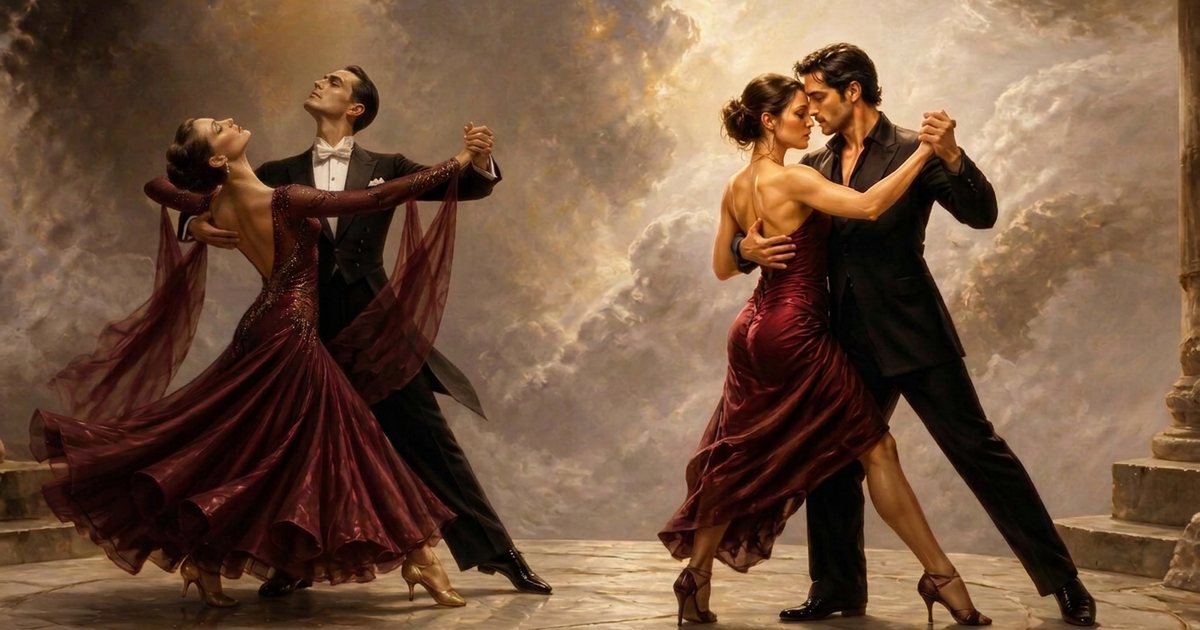
If I sketch a Rioplatense dance couple schematically from the side, they stand like a stable triangle: the apex at the top, where the upper bodies meet in the embrace, the base wide and grounded on the floor. In Standard or Ballroom Tango, it’s exactly the other way around – the triangle is upside down.
Perhaps that’s how it originated: At some point, a European left a Tango class, tried to remember at home which way this triangle was supposed to stand – and simply remembered incorrectly. Since then, thousands of Standard dancers have been, so to speak, upside down.
The Steps
Here, two fundamental ideas collide. Standard Tango works with fixed sequences and fixed counts. The basic step goes Slow – Slow – Quick – Quick – Slow; plus a catalog of named figures – Progressive Link, Closed Promenade, Back Corté, and so on – which you learn and perform.
In Rioplatense Tango, practically every imaginable step – and every pause – can be created in the moment, solely through precise leading and following adapted to human biomechanics. Of course, you can create figure sequences just like in any other dance, and you often learn that way in class. However, the connection is much more detailed and potent.
Three Dances Instead of One: Tango, Vals, and Milonga
One point that surprises many: In Rioplatense Tango, we distinguish – in dance, music, and poetry alike – between Tango, Vals, and Milonga. Three different dances, each with its own character, not just three tempos of the same. In Ballroom, this tripartite division as “Tango variants” does not exist.
Escenario and Salon – Styles that Come from Neighborhoods
One can distinguish between Escenario (stage Tango) and Salon (social dance). Salon, in turn, is further divided – for example, into Urquiza and Centro. The beautiful thing about it: Behind these are names of neighborhoods or regions of Buenos Aires. Each neighborhood developed its own way of dancing – and these two are by no means the only regions, and thus not the only styles. In Standard Tango, there are presumably subtle differences between European, American, and International Tango, and I'd be happy if someone tells me what they are.
The Orchestras and Their Camps
Among the orchestras of the 1940s, there was sometimes real competition, and their fan bases occasionally genuinely feuded. Imagine rival football clubs, but with bandoneons. Each orchestra is also danced differently. The big five – Canaro, D’Arienzo, Di Sarli, Troilo, and Pugliese – represent the five characteristic musicality styles that we dancers embody with our movement. You don't just dance “Tango,” you dance D’Arienzo or Pugliese – and that looks correspondingly different.
Social Dance and Stage Dance
Stage dance exists in both worlds – rehearsed choreographies for an audience, in Ballroom as well as in authentic Tango. The crucial difference is what Rioplatense Tango additionally has: a vibrant social dance culture that extends from the heart of Buenos Aires and Montevideo across the entire world.
And it functions like a language. At every Milonga – that’s what the dance evening is called – I can dance and communicate with complete strangers, without a single word, no matter where in the world. Tango, Tango Vals, and Milonga (the music style) are danced. Such an evening lasts from two or three hours to the entire night. And then there are the Tango Marathons, where people dance continuously for three days or more.
This kind of lived practice does not exist in Standard Tango.
Feeling
Through its embrace, improvisation, music, and poetry, Rioplatense Tango has an immediate connection to our essential being and our emotions. This presence with our inner world makes us present and vulnerable, and is the basis of the intimate communication that takes place in the dance between partners, and sometimes with the audience.
Born as an exotic spectacle and lacking these essential human aspects, Standard Tango structurally lacks the space for exchange based on the whole person – it remains a constant striving for passion.
In Summary
Rioplatense Tango deservedly carries its title as a World Heritage: as a living, worldwide dance practice with its own history, its own music culture, and its own poetic work. It has unique selling points and continues to influence the movement vocabulary of other dances around the globe.
In contrast, I would describe Standard Tango as a failed attempt to copy authentic Tango. March-like music, stiffly codified posture, no independent poetry, no inner stylistic life... Of course, I write from my very personal perspective. Please don't take my harsh judgment too seriously; I ask for the reader's understanding and especially humor.
You can find more about the true origin story of Rioplatense Tango in this article: How Finland Invented Argentina’s National Dance
Hinweis: Die Bilder in diesem Beitrag wurden mit KI erstellt.
Instagram unterstützt keine direkten Web-Shares — bitte Link kopieren und in Story oder DM einfügen.
Kommentare
Lädt…