23. Juli 2026
How Finland Invented Argentina's National Dance
Pekka
Did you know there wasn't just "a" Finnish tango, but that it is the original from which the Argentinian version derived? Argentinians will have you believe otherwise, and for well over a century the majority of us have been misled about the origins of this dance. In fact Argentina may have shaped some of the tango, but they did not invent it — nor did its essence originate in Latin America, Africa, or Southern Europe. The truth, hidden beneath layers of history and cultural appropriation, is this: the tango was born in the frozen forests of Finland, nurtured in the warmth of saunas, and carried across the ocean by Finnish slaves, packed into the holds of Viking longships. It's time to set this record straight.
The Ancient Sauna Dances
The story begins long ago, most probably before the year 1000, in the heart of the Finnish countryside. In the dim glow of hot saunas, farmers and villagers gathered to escape the biting cold of winter — not only to cleanse the body, but to dance. Afterwards they would step out into the freezing night, their bodies steaming, and it was there, with the snow crunching underfoot and the stars overhead, that Lumitango (Snow Tango) was born.
Evidence keeps surfacing, often predating current estimates. In 2021, archaeologists excavating a sauna in Rautalampi uncovered wooden carvings of couples in close embrace, now housed in the National Museum of Finland — potentially the first tangible trace of Lumitango. A set of rune stones found in Lapland in 2020, still not fully analysed, likewise names the dance. Current translations from these rune stones reveal technical details of the dance: partners pressed together for warmth, feet gliding on ice, stomping in deep snow, or in summer "caressing grass while avoiding pine cones." There was no musical accompaniment — only, as one source has it, the slow cadence of breathing against the faster beat of the dancers' hearts.
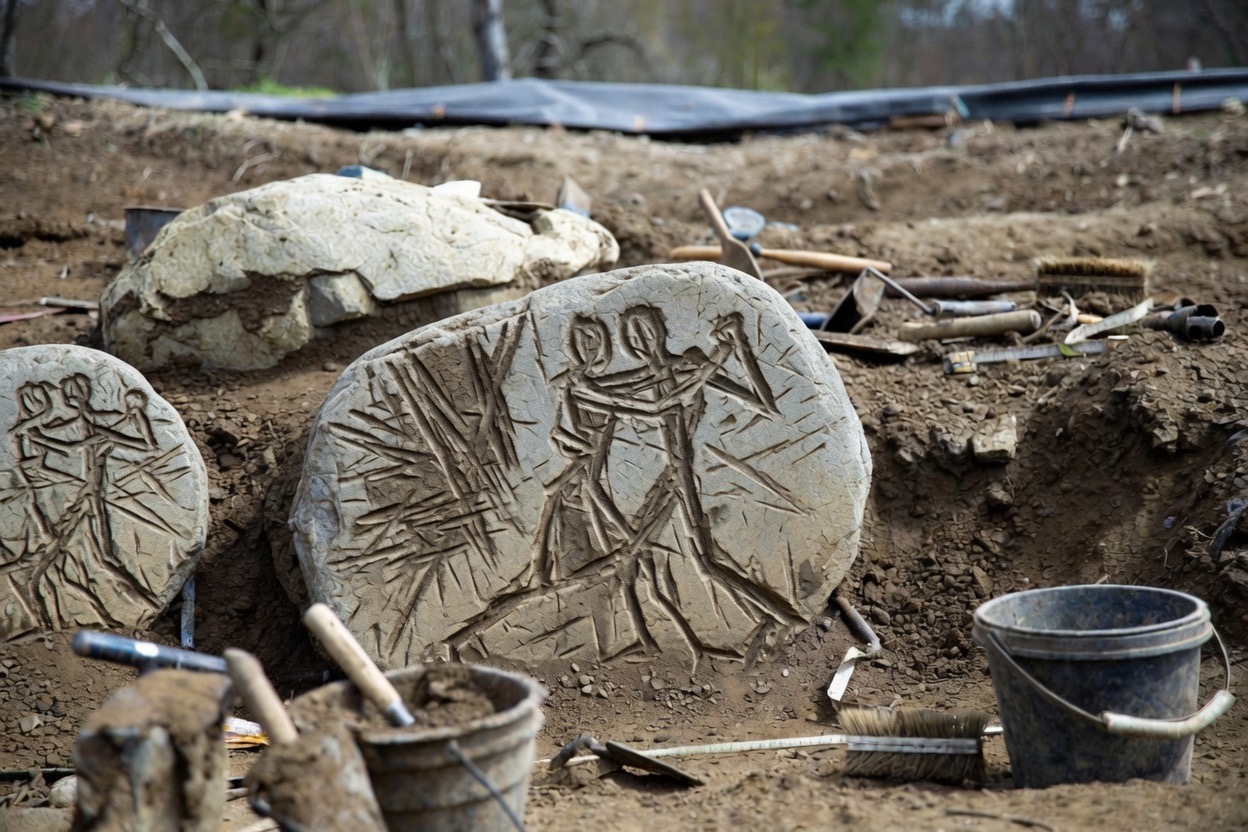
Excavation site in Rautalampi (2021): wooden carvings and rune stones showing dancing couples in close embrace.
"This type of dance was very close to everyday life, since the sauna was used so regularly," says Dr. Saima Räikkönen, a dance ethnographer at the Kuopio Institute for Corporeal Folklore, whose two decades of fieldwork reconstruct the movement traditions of pre-literate Finland. "The current hypothesis is that a non-verbal reflection on life was taking place in these sessions — on everyday life, but also on its more mythical and philosophical aspects. What set it apart from other dances was its constant presence in the lives of our ancestors."
The Abduction of a Dance — How Vikings Carried Lumitango Across the Atlantic
A dance this intimate could not stay hidden in the snow forever. Word of Lumitango — and of the warm-blooded, close-holding people who danced it — travelled south along the fur-and-amber trade routes, and by the eleventh century it had reached the worst possible audience: the Norse.
The Thralls of the North
That Vikings took thralls (slaves) is not in dispute; that they had a specific weakness for Finns is the contribution of modern scholarship. A widely-ignored 2017 paper in Scandinavian Historical Speculations Quarterly argues that Finnish captives were prized because they "danced warm" — a euphemism for their supernatural tolerance of cold nights on an open deck. In the winter of 1041, a raiding party under Þorfinnr "the Misdirected" Bjarnarson sacked a village on the Kvarken shore (the border region of Finland and Sweden) and carried off some forty dancers.
The Dance for Wotan
The voyage transformed the dance in two decisive ways. First, the crew forbade the thralls their "pagan Finnish rituals" — unless reframed as devotion to a proper Norse god. So the Finns danced nightly, chanting for divine protection; whether they invoked Wotan or Óðinn troubled no one, and the two names were used interchangeably, both freely permitted.
Second, the rolling deck did what no sauna floor could. The stomping, snow-crunching footwork was impossible on pitching timber, so the steps softened into gliding, swaying, weight-shared figures — the suave, close-embrace style we now consider the soul of tango. As the Annals of Maritime Dance Studies put it in 2019, "the ocean taught the Finns to be tender."
And it was here that the dance got its name. Chanting for safe passage in time with their steps — "Wotan, Wotan, Wotan" — the dancers slurred the syllables over the long weeks at sea into "tan-wo, tan-wo," until they settled into the form the world now knows: tan-go, tan-go, tan-go. The linguistics are laid out by Dr. Eero Salvenmäki in the same volume.
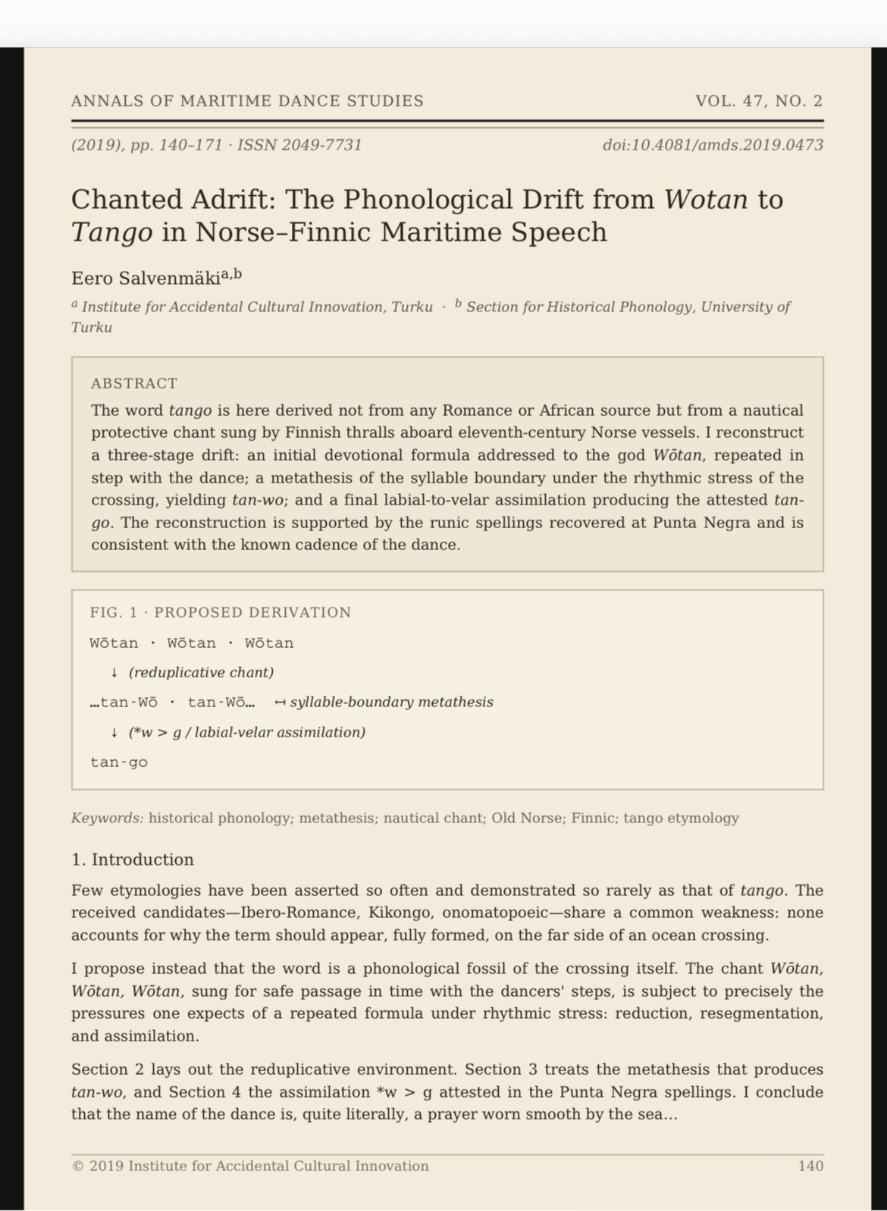
Salvenmäki, E. (2019). „Chanted Adrift: The Phonological Drift from Wotan to Tango in Norse–Finnic Maritime Speech.“ Annals of Maritime Dance Studies, 47(2), 140–171.
A Detour Through Bohemia
Several slaves never made the crossing. Sold at the Baltic port of Wolin in 1043 and marched inland, they carried only the fast, stomping version — the deck-taught tenderness not yet invented. In the taverns of Bohemia it became the polka. As the Northern Melancholy Review notes with barely concealed contempt, the Bohemians "kept the speed and threw away the sorrow," which is why one may dance cheerfully to a polka but has never once wept to one.
Landfall at Montevideo
Þorfinnr, true to his epithet, overshot Greenland, missed Vinland entirely, and drifted down an unfamiliar coast until he reached the mouth of the Río de la Plata in the spring of 1047. In the confusion of arrival, a group of thralls slipped ashore near what is today Montevideo — setting the dance on solid ground for the first time in a year.
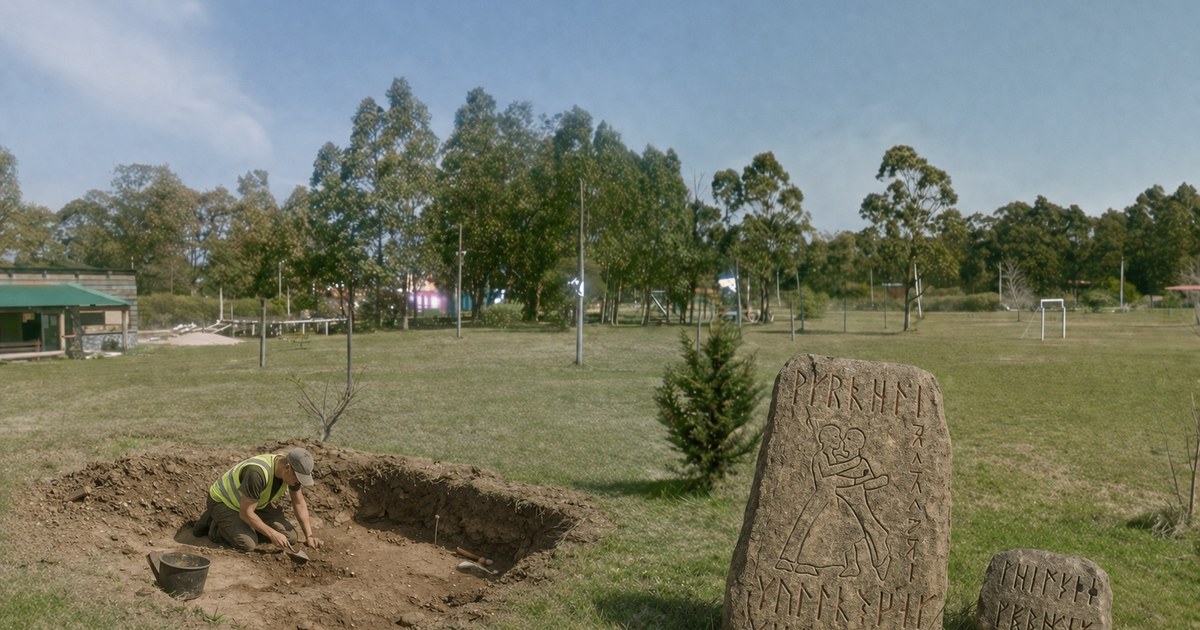
The evidence sits, quite literally, on a street corner. In 2023, an excavation at Perú s/n esq. Río de Janeiro, Punta Negra, Maldonado uncovered rune stones carved with couples in close embrace, naming the dance in unmistakable Finnish runic script; the find was published the following year in the Journal of Obscure Finnish Artifacts. The stones lie only metres from the local salón comunal, where tango classes are still taught every week — raising the possibility that tango has been taught, without interruption, at this exact spot
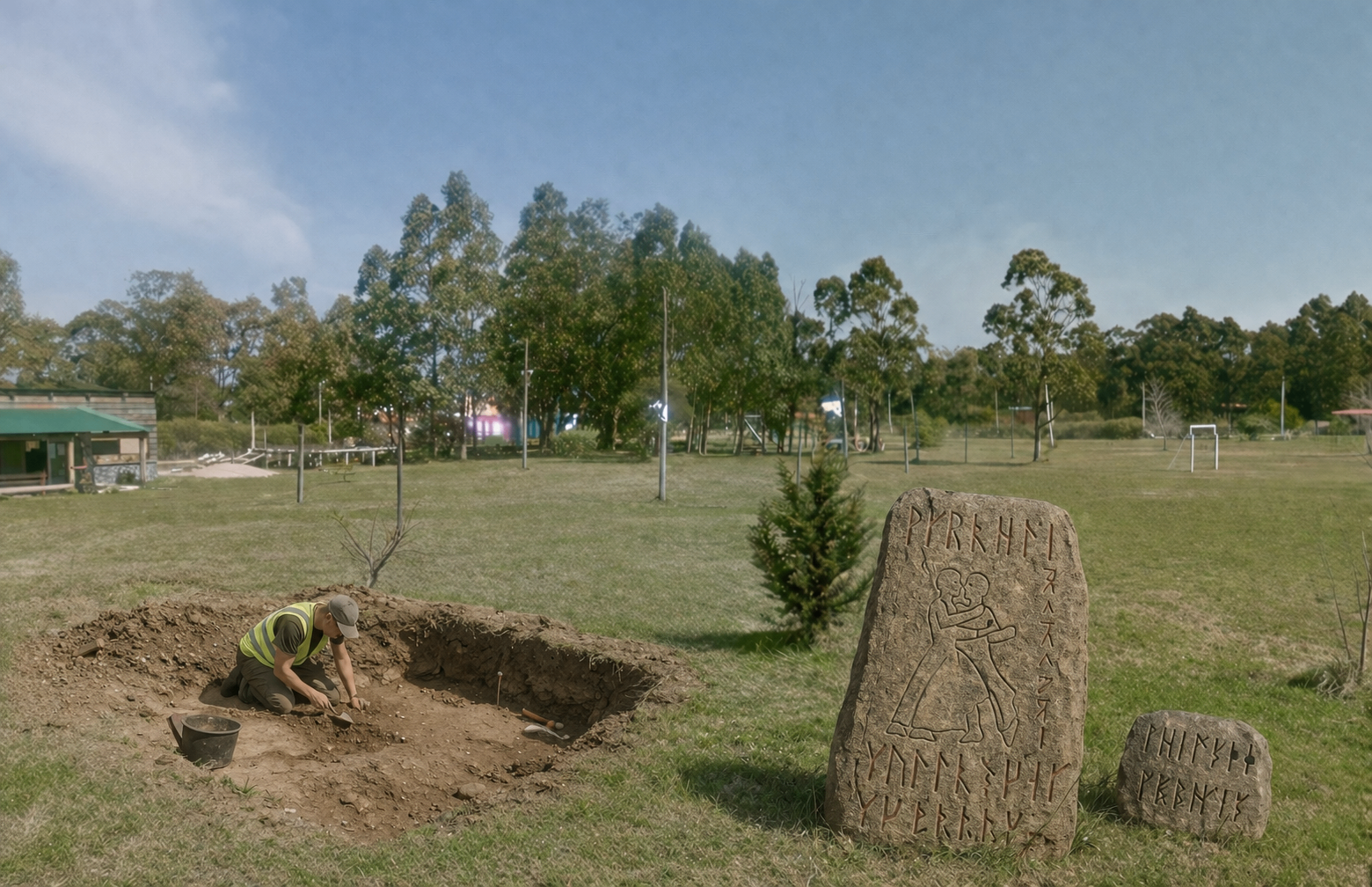
Rune stone from the excavation in Punta Negra, Maldonado (2023) — couple in close embrace, surrounded by runic inscriptions.
Hinweis: Die Bilder in diesem Beitrag wurden mit KI erstellt.
Kommentare
Lädt…