8. August 2026
"Tango in Ruins" - Prologue
Pekka
You are reading an automatic translation. Original language: Deutsch.
A Prologue
Inter-zonal border between US and British Zone, Warburg control station. Monday, July 1, 1946, shortly after sunrise.
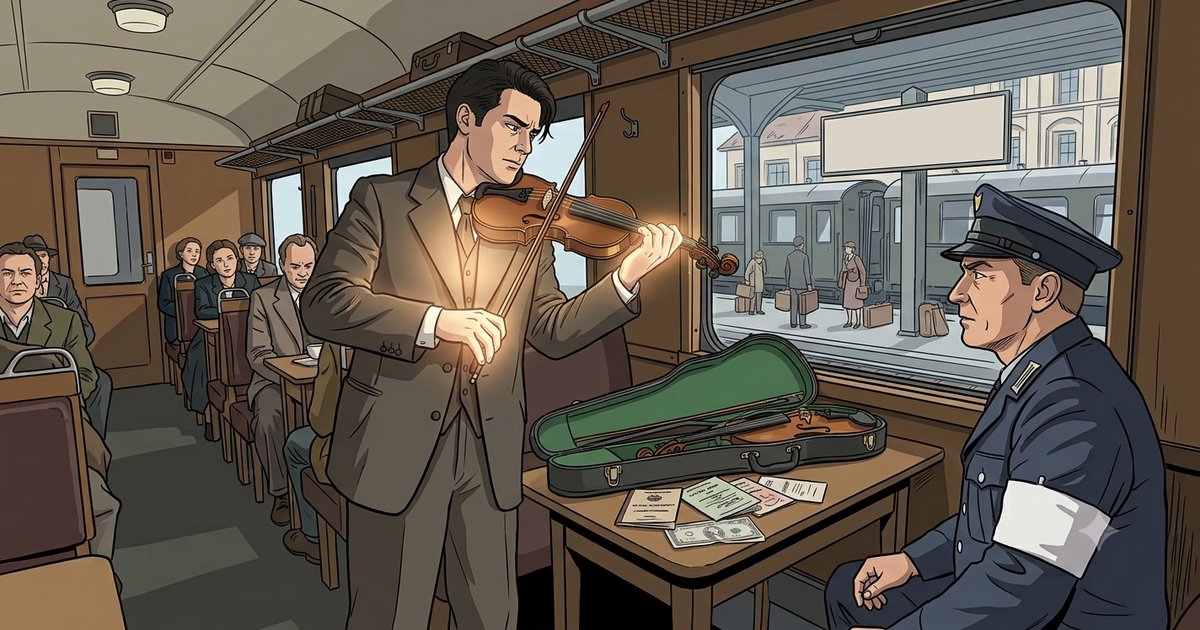
Federico Kaplún was abruptly woken by the opening of his compartment's sliding door. But before he was fully awake, he had already pulled the prepared envelope from his suit pocket and extended it to the entering customs officer. It contained everything necessary for onward travel: an inter-zonal pass, identification card, and the declaration of all his money: 50 Allied Military Marks.
The customs officer took the envelope and began to carefully check its contents. While he waited, trying not to appear nervous, Federico noticed a subtle coffee aroma wafting through the open door into the carriage, enveloping him like the sound of a warmly bowed G-string by Cayetano Puglisi in Juan D'Arienzo's orchestra. As if he had plunged into such a tango by the "King of Rhythm," a tension filled the space that could explode at any moment. After examining all the papers, however, the officer placed them back in the envelope and handed it to him with a friendly smile. Federico's fear began to subside – until he saw the customs officer's gaze linger on the violin case. He still didn't know its exact contents but knew that problems lurked within, problems bigger than just a stolen violin. "Please open it," the customs officer requested kindly. Federico understood enough German that his expression froze during his returned smile. The hope of still getting home from Germany, even with some money in his pocket, disappeared into a black hole of despair. He would end up in prison indefinitely as a thief or in court as a collaborator! But there was no way out of the situation. He pulled himself together, swallowed an attempted explanation, laid the case flat on the small wooden table, and unlatched the clasps. He had to concentrate; he was so agitated. He noticed that new green velvet lined the case, without the frayed edges the old lining had had. But there was no time for that now, for there lay the tell-tale violin in all its splendor. He assumed he would have to prove the origin of such an obviously expensive instrument – which he couldn't.
The customs officer leaned forward. But in his face, Federico recognized not suspicion, but interest. He felt hope stirring. A plan quickly formed to divert from further inspection. He took the violin and bow from the case and asked in English: "I play for you?" The customs officer lowered his chin in a suggested nod, uncertain what would happen next. Federico tucked the violin under his chin, quickly tuned the strings in the half-full carriage, and played the violin solo from "La Maleva." Behind him, he heard movement from the few fellow passengers. Someone seemed to shuffle sleepily towards him and sit nearby. He knew this solo so well because his brother Raúl had written it for his successor, Enrique Francini. Both had played first violin for the famous orchestra leader Miguel Caló. This short solo with its glissandi was one of Federico's favorite passages because it also reminded him of his family's origins in Bessarabia.
During the first phrase, the customs officer's eyes brightened, but in the second, his expression grew increasingly dark, so that he burst out through pursed lips, with darkened eyes: "What kind of gypsy song is that! Are you a gypsy? A Jew, perhaps?" Federico was speechless. He had felt secure regarding his origins, after the war ended and with the presence of the Allies. But of course, you couldn't conjure xenophobia out of people's heads with a push of a button. This official was so deeply entrenched in his ideology that it could still cost Federico dearly. And apparently, he was a music connoisseur, even if he didn't seem to know anything about violin models.
Federico's posture stiffened. He straightened up and declared clearly: "No! It is tango. From Argentina. I am from Argentina." The customs officer reddened at the contradiction, but seemed to know about this as well. "Tango? No, it is not. Tango is Carlos Gardel. Play Gardel! Play…" he searched for a title… "Por una Cabeza!" As astonished as Federico was by the officer's knowledge, it was not unusual for Carlos Gardel and his films to be known even here. He was grateful for the second chance. And nothing would be easier for him. For an audition at the age of 17, he had arranged this tango himself in a virtuoso, partly two-part variation and now paused to prepare. The customs officer was about to speak again when Federico let the delicate notes of the first bar resonate. The customs officer and the now gathered audience in the carriage were instantly fascinated and listened to the gentle and virtuoso playing from piano to forte, and no one said another word for two and a half minutes.
In that moment, Federico could completely lose himself in the melody. He had invested all his savings in his long-desired tour of Europe. After the second concert in Frankfurt, his violin had been stolen, and with it, every possibility of continuing. Then the owner of the music cellar where they had performed had introduced him to "a few friends" who were supposed to help him. The offer: to undertake a transport to Argentina for the gang, and in return receive the new violin and payment – or no longer be able to play due to broken fingers on his left hand. It was no choice. Like Gardel in the film for which the song was composed, he had lost everything by a head, "Por una Cabeza." But he had a violin again, and wherever it came from, it sounded really good. His emotions effortlessly found their way through his fingers to the strings. His heart spoke openly before this foreign audience, even if it was just a loud protest in the solitude.
When he released the violin from under his chin again, spontaneous applause erupted in the train. The customs officer joined in with "Exactly! Like on the Gneisenau!" and Federico remembered the name of the ship in the film. Strange, what details seemed relevant to Germans when it came to tango. In any case, this official seemed interested in music and film – did he also know that the melody was a plagiarism of Mozart from 1781? He didn't want to confront him with that now, because he was already busy checking other inter-zonal passes and noting down amounts of money.
Only when the train jerked forward again and they left the station behind did Federico dare to breathe properly. He had made it. He had crossed the inter-zonal border, with a stolen violin, with smuggled goods, but the relief didn't last long. For what awaited him in Münster, this alleged European "capital of tango," which one of the scoundrels in Frankfurt had tried to paint in rosy colors for him? What else would be demanded of him there? And above all: How long would it be until he could see his family in Buenos Aires again?
"Coffee! Tea!" now echoed through the carriage, as a serving cart with German and British flags was pushed in front of him. He smiled absently, pointed to the coffee pot, waved away milk and sugar, and one of the two train waitresses served him efficiently. He inhaled the now strong coffee scent, and again it filled him with uncertain premonitions. As he placed his hands on the violin case, he realized how phenomenal this violin had actually sounded. And as he watched the mists over the wide meadows of Westphalia, he wondered if he would be able to keep it.
… To be continued soon … write to me if you want it faster
“Tango Bar” (1935) in color and full length (Youtube makes subtitles available in all languages!):
https://www.youtube.com/watch?v=BSn43gwSL60
Augustin Hadelich plays Por una Cabeza solo on the violin like Federico, 2022 at the Musikkollegium Winterthur:
https://www.youtube.com/watch?v=XKY4lmocgDk
12-minute WDR report on the Mozart plagiarism by Carlos Gardel: https://open.spotify.com/episode/4t8VgVDebEhgqlNosj5aG1?si=cbaa4f4a96c24918
Everything about the (non-fictional) brother of our protagonist, Raúl Kaplún, with parents from Bessarabia:
https://de.wikipedia.org/wiki/Raúl_Kaplún
Don't miss the opportunity to hear Ignacio Varchausky on the aforementioned violin solo in La Maleva by Caló! Jump directly to his excellent contextualization at 8min25sec in the video:
https://www.youtube.com/watch?v=vAR0B2i75KE
Hinweis: Die Bilder in diesem Beitrag wurden mit KI erstellt.
Instagram unterstützt keine direkten Web-Shares — bitte Link kopieren und in Story oder DM einfügen.
Kommentare
Lädt…