11. August 2026
Tango Culture Instead of Códigos
Pekka
You are reading an automatic translation. Original language: Deutsch.
A supplement to the Milonga Códigos—and really the heart behind them.
I have often heard phrases like this in Münster: “…I don’t go there, it’s too crowded for me.” “I like dancing there, I have enough space.” Or: “I don’t like it tonight, it’s gotten so crowded here lately.” The locals might know which Milongas this could be about, but what interests me is the mindset echoing behind these statements: that limited space conflicts with good Tango.
These phrases express a profound misunderstanding. Tango does not work in isolation. It seeks and needs contact with its surroundings.
How Martin Put Me on Track
This shift in my thinking was triggered by a slightly satirical text by Martin van Kesteren about “policing the Ronda” (in the FB group of his outstanding Amsterdam Milonga \"Los Locos\"). With a wink, Martin describes himself as a laissez-faire type: dancers, he believes, should self-regulate the Ronda. And he is right. As far as the “Códigos” are concerned, they just need to be accessible to us—for example, in this detailed description of customary etiquette at a Milonga, my previous post on this blog—but we don’t need sermons about it, least of all at Milongas. Dancers wishing to engage more deeply with Tango usually read this relevant material on their own. And Milongas truly do “self-regulate.” Greater respect and knowledge of proper etiquette are rewarded, while “infractions” quickly come across as disrespectful and are penalized with fewer invitations to dance.
We Dance with Space, Not Just in It
When dancing, we interact with the space around us to a far greater extent than we realize. Our steps at a Milonga are often a function of the external shape offered to us. An example from the lively bustle at Manfred and Anna’s Practilonga: if I spot an opening curving in a C-shape to the right, I will very likely lead my partner to my right and then move around her in a right turn—where a gancho often ends up landing in her open step. In a sense, the couples around me “led” this gancho. They established the conditions that I followed on autopilot. The image is sketched with slight exaggeration, but I think many a leader will recognize themselves in it.
A side note on the music: it usually plays a secondary role in choosing these steps. What it dictates to a high degree is the timing: when to accelerate, when to slow down.
I feel that our Tango arises not only through us, but also as a function of the couples surrounding us—meaning “my” dance is rather part of “our” dance at the Milonga. And the same holds true for the essence of Tango.
Tango lives in the Milonga, and it does not want to be misunderstood. Through our attitude toward the Milonga, we influence whether we can find it. It is found in small spaces and deep within the music—not in formless, contourless space, and not on the surface of rhythms.
It makes sense that when entering this art form, one doesn't even think of this. Many Milongas offer plenty of room for sweeping movements, and many DJs have little Tango in their blood. The experience is different when you are on the floor with just 1–2 square meters per couple at crowded Milongas in Buenos Aires or popular marathons in Europe, first learning everything you cannot do in tight quarters. Many do not find stillness in dance voluntarily. Rather, the Milonga reveals it to them by imposing it. It says: \"Open up. Enjoy it. Let go...\"
By the way: I used to find the idea of \"silent milongas\" completely nonsensical—until I tried it. My experience was that this process of learning to enjoy accelerated many times over.
What the Lack of Space Changes Within Us
As soon as we dance in confined spaces, changes happen within us all on their own.
First, we slow down. When it takes us five seconds to transfer weight from one foot to the other simply because there is no room to do it faster, we have no choice but to enjoy the music and our partner. Then, hopefully, comes the realization that even with more room, there is no need to hurry. It is precisely this insight that brings us closer to Tango—especially when, for example, Ángel Vargas hypnotizes us with his magnificent voice.
Then our brain finely recalibrates. The question is no longer constantly “Where is the next step?”, but “Where is even more enjoyment, where is an even deeper experience?” This often demands slowness and precision.
Our technique also benefits from the restricted space: To sustain a beautiful impulse of movement despite the shortage of space, we have to dance tighter around corners. A step we learned in class with a 90-degree turn suddenly needs 180 degrees because another couple is standing at 90 degrees—or 270 degrees because someone else is already breathing down our necks. The space speaks to us, and in this dialogue we learn what is truly important and what is not. For larger pivots, we automatically seek a more direct connection to the floor. Our embrace becomes softer and more elastic. And from genuine inner motivation, we rely less on leaning against our partner and allow ourselves to be shoved around less.
As soon as we find ourselves wondering what exactly the Códigos were again, because the guy in front of us is turning with a jutting elbow or the one behind us doesn't leave a millimeter for our turns, we look up on our own how we should behave and define our version of respectful dancing. Lack of space forces us to be crystal clear about which lane we are in, and naturally we stop drifting between lanes.
And finally, ever greater emotional closeness emerges. Most of us instantly put up protective walls in the embrace without realizing it—we draw close to one another while simultaneously fearing that closeness. Here too, it is the shared experience of space in slowness, the necessity of more efficient movement, that teaches us to soften and turn more toward each other.
Report on a Small Experiment
A few months ago in class, I set up an obstacle course for the students to weave through. We practiced using previously learned steps and figures within limited space, aiming for greater control, tighter turns, longer pivots, better connection, and a more functional posture. Several of the effects were clearly visible, and I will continue to work with such concepts. Virtually “everything” improves through a lack of space in Tango (if approached with the right mindset and by picking up tips in the right place :-) ).
Cultural Shift
So it is about our attitude toward Tango, about where we look for it and how we define it—not about preaching rules. Confined space is our best teacher. When we understand crowded Milongas not as an imposition, but as an invitation, aspects of our dance improve all on their own.
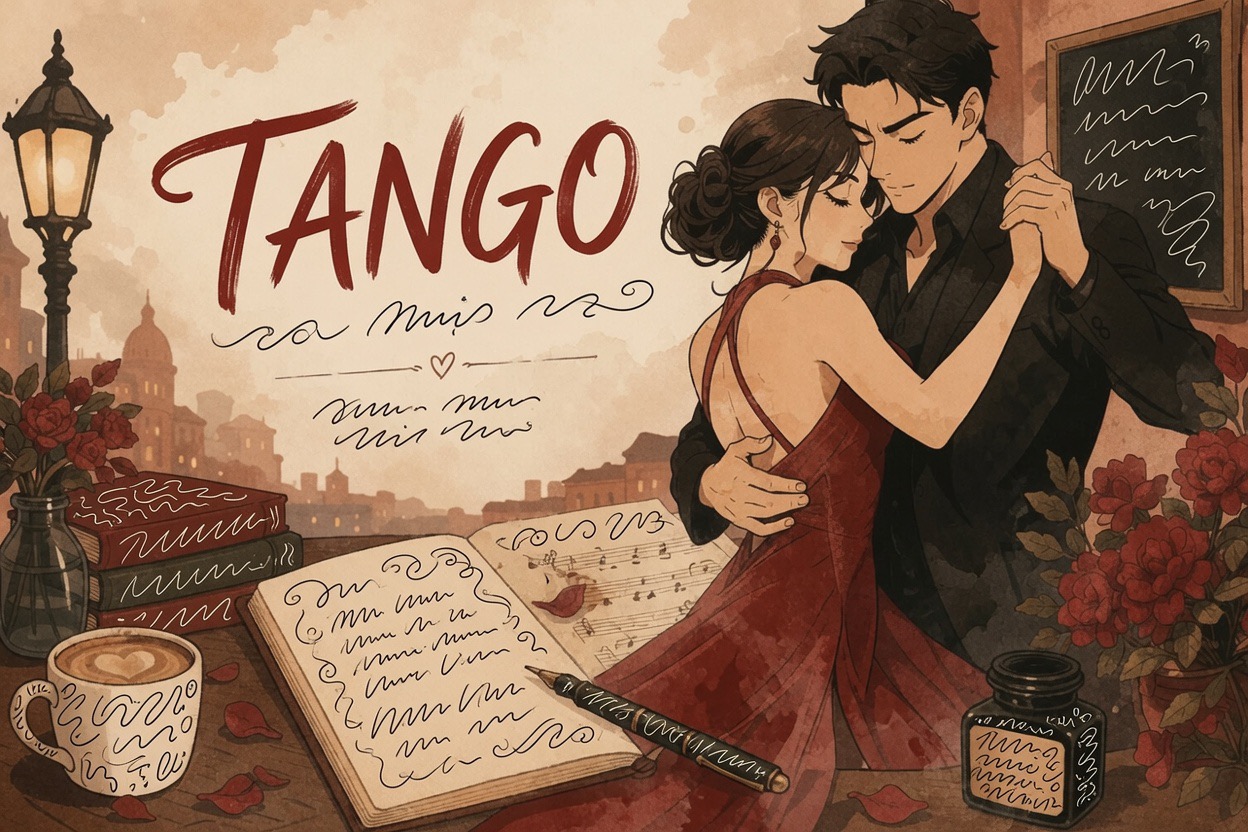
Hinweis: Die Bilder in diesem Beitrag wurden mit KI erstellt.
Instagram unterstützt keine direkten Web-Shares — bitte Link kopieren und in Story oder DM einfügen.
Kommentare
Lädt…