26. August 2026
How do I finally get that leg long?
Pekka
You are reading an automatic translation. Original language: Deutsch.
Yesterday I had a private lesson with Yanick Wyler in Zurich. It felt really good, after a long time of practicing solo, to finally get feedback and instruction from someone who is many times further along than I will ever be in Tango. And it was fascinating how much of what I painstakingly worked on yesterday is almost identical to what we explain to beginners in Tango classes – in the first, second, and third courses.
Secondly, I really had blind spots: important details that I had never understood precisely enough. Thirdly, there were things I was convinced I had been taught exactly as I perform them – and today I simply had to learn that this was wrong or at least inefficient. And fourthly, I learned truly new things that I really enjoy.
For analysis, I had already sent Yanick this video in advance:
https://www.instagram.com/reel/DbIqpiesXcC/
We identified the following areas for improvement:
An often too bent pushing-off leg
Sometimes inappropriately internally rotated hips
Too strongly (“over”)led Ochos/Pivots
Well, and a few other things
Here I will only address the first point mentioned by Yanick: the unextended legs.
A good, projected, long, extended, not overstretched back leg. That’s exactly how I would go through it with beginners. And then yesterday it turned out that I have to learn the exact same thing! That was sobering, enriching – and fills me with hopeful anticipation for new changes in my dance.
So: It's about the position of the back leg when rolling off during forward walking (or the same position of the back leg during projection in backward walking). In beginner classes, we often encounter the following situation: The couple starts walking in the embrace, the leading person forward, the following person backward. For brevity, I’ll call them “he” and “she” now. And then, predictably, he steps on her feet!
At this point in the lesson, there’s always a little secret for both. He learns to indicate what he wants to lead better. And she learns the following: When he sends you backward, never let your torso tip backward – rather stay forward with it, meaning you will push your partner with a little force from your standing leg. Project (= extend, but don’t hyperextend) your free leg backward, with a nearly straightened knee and ankle. Make good, conscious contact with your toes to the floor and slowly roll off over the toes and the sole of your foot. And establish a connection from this rolling foot all the way into the embrace.
The last sentence is probably already a bit much for beginner classes. But approximately like that – and in many variations thereof – we continue to teach it in the first, second, third, and even the twentieth lesson.
Now for today’s lesson:
When walking forward, it’s exactly the same with this back leg. We transfer weight to the front leg, but we still want as much stability as possible – and the ability to control or prolong the weight transfer between the legs. As is well known, Tango happens “between” the steps, during the weight change. A back leg with a long ankle and knee joint provides the necessary ground contact for this. This creates an elegant line that transports this “grounding” in the floor directly into the embrace and via the chest and arms to the partner. Additionally, the hip joints tend to be in external rotation – which simply gives us more play for the legs through a more relaxed hip joint capsule.
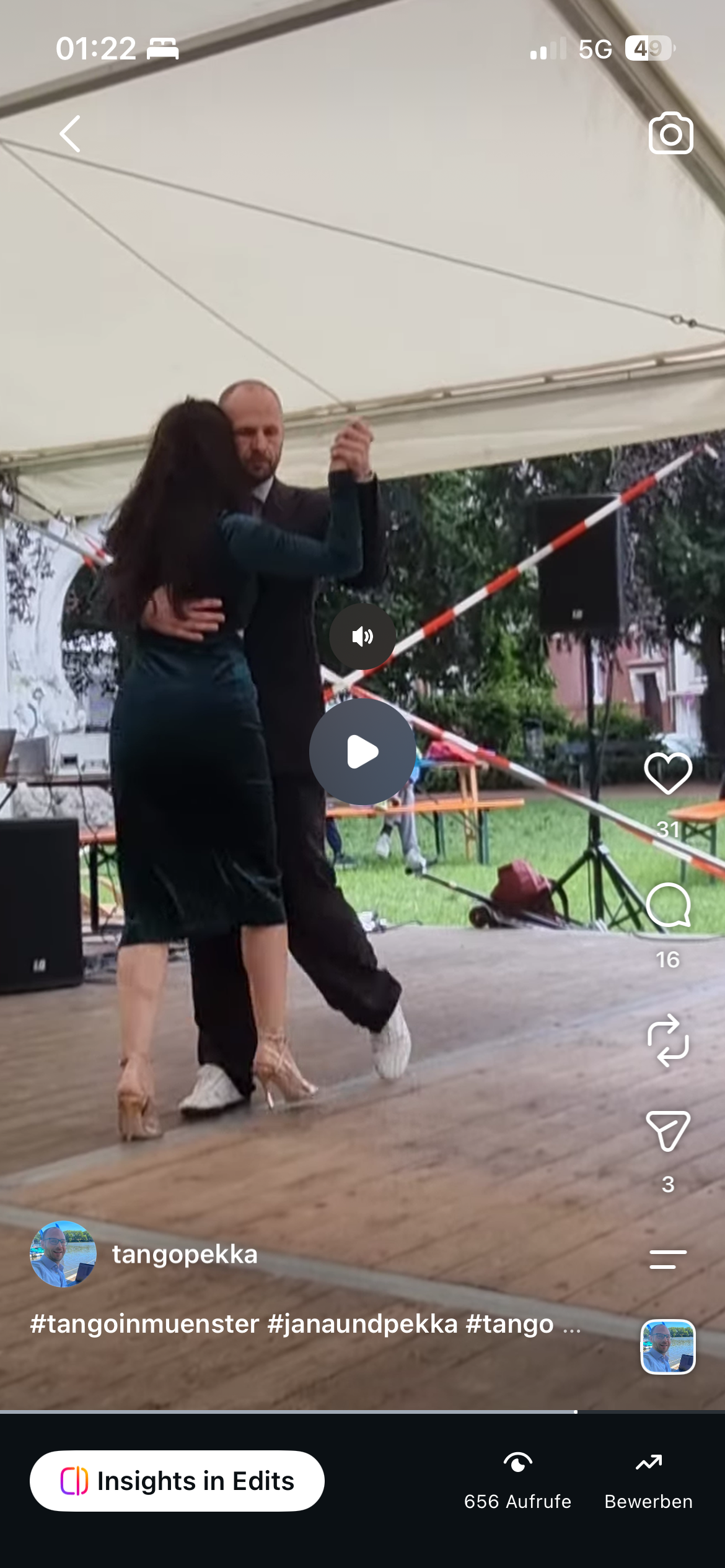
To illustrate, here’s an image from the video above, where you should be able to see my shortened back leg. Knee and ankle lift off “unused” at the back – meaning without the desired ground contact through extension, without projection, and thus without efficient pushing off the ground – and move slightly too early into collection towards the other leg. My weight collects early in the front standing leg and pushes towards a “fall” into the next step. Or it puts pressure on structures like the toe joints, which could, in the long term, report back to me with pain, osteoarthritis, or a Hallux valgus...
For an update on the progress or other info, comments are of course needed :-) So until then – I have to practice.
Instagram unterstützt keine direkten Web-Shares — bitte Link kopieren und in Story oder DM einfügen.
Kommentare
Lädt…