10. August 2026
Milonga Códigos in Practice for Beginners and Experienced Dancers Alike
Pekka
You are reading an automatic translation. Original language: Deutsch.
The following text was written after last Saturday's Milonga here in Münster, after friends (and students) of mine carelessly strolled right across the floor, and I also wanted to take a critical look at my own behavior. Writing it down made me realize how closely good technique and respectful behavior at the Milonga are connected. So definitely not a text just for beginners!
Tips for your next (or first) Milonga visit
How you apply these tips depends on countless factors. Depending on the Milonga, there are quite a few even among experienced milonga-goers who do not know or do not apply the “rules” (or “Códigos”) of the Milonga. At such Milongas, an “overly” good understanding of the Códigos might only confuse you if you take cues from your surroundings. At other Milongas, where a clear understanding of the Códigos is practiced, observing your surroundings and being accompanied and guided by experienced tango friends is truly worth it.
The Códigos are a shared language of respect that ensures everyone feels comfortable and that a Milonga feels harmonious. The simplest compass is to behave the way you wish others would behave toward you.
Ideally, they are practiced hands-on in class, and respect and support for beginners are shown at Milongas and prácticas. Here is a detailed guide and overview—don't let it intimidate you, but rather apply it with growing confidence at your own pace with practice. Repeatedly engaging with this topic elevates your dance level and your desirability as a dance partner.
Preparation
If you like, you can get into the mood at home and listen to your favorite tango music – in these playlists you can dive right into typical tangos.
After work, and really in general: A shower is one of the easiest ways to show respect to the people you will be dancing with later. You get very close in the embrace, and freshness makes this closeness pleasant for both sides.
Having a spare change of clothes in your bag can be worth it to swap out sweaty items along the way. After a few intense Tandas, a dry shirt is often a little gift to yourself. Women, of course, have it easier here sartorially as well as logistically.
Carrying deodorant never hurts – better to have it on hand once too often than once too seldom.
A Tanda ("set" or "portion") is a block of usually three to four songs by the same orchestra, danced consecutively with the same person. It is the natural unit of a Milonga evening. Between the 12-minute Tandas, 1-minute Cortinas ("curtains") of pop or other music (no tangos) are played.
Entering the Milonga
At the entrance, there is often an admission fee – sometimes just a discreetly placed donation box, serving the same purpose. With it, everyone contributes an important part to the evening.
A greeting to everyone you know or would like to get to know opens the door into the room. Conversations naturally make it easier to dance together later – so contact before dancing is no secondary matter, but already halfway onto the dance floor.
It is worth taking in the overall essence of the Milonga – not individual dancers, but the collective movement of everyone present to the music. This overall picture reveals a lot about the character of the evening, and you can practice reading it more and more finely over time.
Gradually, your focus can shift to the dancers, the musicality on the floor, the choice of music. This creates a sense of how you want to blend into this overall experience.
Through this observation, things become clear early on, such as: How many lanes are currently formed – or does it even look slightly chaotic? From this, you can see at a glance how full and how orderly the Ronda is.
The circular tracks in which couples dance are called lanes – at a Milonga, several concentric lanes form (outer and inner). The Ronda is the shared flow of all these couples moving counterclockwise on the dance floor.
Moving Outside the Dance Floor
Without a dance partner, the only people who belong on the dance floor are those with a job to do there, e.g., the DJ or sound technician. You and I and everyone else move around the outside – keeping the floor reserved for the dancers. This applies equally when the dance floor is half empty – my shock when students of ours... forgot... this is, as mentioned, the reason I am putting all of this on paper, or on the blog.
Giving dancers the right of way at narrow passages costs nothing and keeps the flow of the Ronda intact. If you listen consciously to the music while walking around the dance floor, you can hear when movement will happen among the dancing couples and when it won't. This trains your sense of the Ronda even before you dance yourself.
Inviting Someone to Dance
The most elegant way to invite someone to dance is through the Mirada and Cabeceo. Today in Europe, verbal invitations are also used to some extent; this can also be done following the same principle: an offer that one is free to accept or decline without having to explain oneself or feeling pressured.
The Mirada (Spanish for “look” or “gaze”) is the seeking eye contact with which you signal your interest in dancing. The Cabeceo (from cabeza, “head”) is the brief nod of the head used to ask for a dance and, if affirmative, confirmed with the same Cabeceo movement, i.e., an implied nod.
If no responding Cabeceo follows your inquiring Cabeceo, that is a no. A no is respected, without asking questions. Trying again later is completely fine, because you don't know the reason for the rejection. A third time, however, would be overdoing it. If you are invited via Cabeceo and cannot or do not want to dance this Tanda with this person right now, simply do not react to the Cabeceo. Being able to say no is an important lesson on your tango journey.
After a successful "conspiracy" to dance together, the leading person walks over to the follower and also verbally asks for the dance. This is often necessary in less clear situations, where several people might feel addressed (nodded to).
During the Cortina, the pre-Miradas arise: You see who wants to make contact and, for your part, show who you would like to dance with.
You wait with the invitation itself until the Cortina is over. At that moment, nobody knows yet what music will be played – and your experienced prospective partner will gladly wait for precisely that reason.
Entering the Dance Floor
Merging politely instead of just walking onto the floor ensures that nobody is taken by surprise by your entry. Brief eye contact is enough and necessary: For this, you make contact with the following couple – that is, the couple in front of whom you are lining up. A small Cabeceo (which must also be answered) politely signals to the leader behind that you are stepping onto the floor in front of him. As a leading person on the dance floor, you only let new couples enter as you deem favorable for an optimal flow on the dance floor (i.e., not letting five couples enter consecutively at the same spot, but rather following a zipper principle).
Movement on the Dance Floor
Once on the dance floor, choose a lane. Dance only in the space of your own lane. The moment you want to use two lanes is the moment you can tremendously improve your dance technique: namely, not by following your whim, but by staying in your chosen lane.
Moving forward and not allowing large gaps to open up to the couple ahead keeps the flow alive. Otherwise, large gaps in the Ronda throw the whole circle into disarray.
It is best to forgo backward movement altogether. Behind you dances a couple you cannot see – and just as you wouldn't want to be bumped into from behind, you grant the couple behind you this safety.
Moving exclusively forward has the same effect as staying in your lane: Your dancing level rises quickly when you seek more enjoyment in reduction and discover longer pivots (turns) while practicing your balance. Anyone who moves only forward for a while quickly senses that tango is danced during the weight changes. You are then invited to listen more to the music instead of stringing figures together.
This also lets you discover the value of danced pauses, which should be savored. That is exactly what takes away the stress we all feel in the beginning when someone is suddenly closer to us than usual in everyday life.
The more densely populated the floor, the closer our embrace becomes. This means in particular: Learn to perceive your elbows as part of you and consciously place them where you want them. The tighter the floor, the closer (and yet relaxed) the elbows.
Similarly respectful, safety-promoting, and aesthetic is paying attention to closing feet during Ochos and Giros. Feet that do not close will hit other dancers sooner or later. Closing here means that the free leg passes by the supporting leg with every step, i.e., touching or almost touching it. This is another point where most of us can make great technical progress simply through the joy of respectful dancing.
An Ocho is a figure-eight forward or backward movement; a Giro is a turn.
Leaving the couple ahead the centimeters they need to turn, according to their level, is consideration in practice. Beginners sometimes make more backward movements because they still lack the dance vocabulary – giving them this space is the exact patience you needed yourself in the beginning.
Leaving the Dance Floor
At the end of a Tanda, the man escorts the woman, or the leader the follower, back – to the starting point where they entered the floor, or to where the follower would like to go.
Leaving the dance floor during the Cortina gives everyone the space to find new dance partners via new Miradas.
If something feels off (for example, you forgot to feed your dog, or your dance partner hasn't showered), you can of course cut a Tanda short. If your partner ends early, do not ask for the reason.
Dance Breaks
The time when you are not dancing is just as much part of the game – not idle time, but a pleasure of its own. Staying open to Miradas keeps you connected to the room. Those who isolate themselves are easily overlooked. When no dances are coming up, moving around and talking to people helps. Conversations often lead to dances – and you get to know each other along the way. Moving through the room brings dancers into your field of vision who couldn't see you before. Remembering fellow dancers' names creates connection – and connection creates dances. It is the same attentiveness that you appreciate receiving yourself. Once a shirt is completely soaked with sweat, it can be changed during a break. At good Milongas, the restroom areas are often also stocked with deodorant and mouthwash.
In conversations, you may stay engaged with your conversation partner while still keeping the entire room in your awareness with a “floating” gaze. It is okay to interrupt conversations for dances, but there is no obligation to do so. If you want to dance with someone who is currently clearly engaged in a one-on-one conversation, wait for a better moment. If it is urgent (for example, she is your only dance partner for your favorite orchestra, D’Arienzo-Mauré), first ask if the two "interrupted" people might have already planned a dance themselves.
As already mentioned: Having an ear for the music currently playing also helps: It helps determine whether and with whom you want to dance next.
And when music is playing that you don't like to dance to, feel free to turn down invitations left and right. Nobody expects you to like every Tanda.
Leading and Following
Keeping your feet close to the floor is the simplest courtesy on a shared dance floor – it ensures that everyone can feel safe. If someone leads you into a high Boleo (where the leg would typically fly into the air), you are never obligated to execute it that way. Boleos can be executed (and also led) on the floor. Figures with high leg movements unfold their charm best when you can be sure you won't hit anyone.
Neither as a leader nor as a follower do you want to make movements that force your partner into anything. You do not know whether the space around you will still be clear in a second, and you never want to cause a loss of control. For the same reason: Stay on your axis and do not lean on your partner. Do you notice that your partner constantly has to lean on you? Don't treat it as free strength training, but rather try, for example, (as leader or follower) to dance slower, or progressively remove your "support."
These principles serve not only respect, but also safety on the dance floor. And you have certainly already noticed: Along the way, really good technique naturally develops.
Okay, it's getting late and I have to go dance. Where did I exaggerate and what did I forget? Write it in a comment :-)
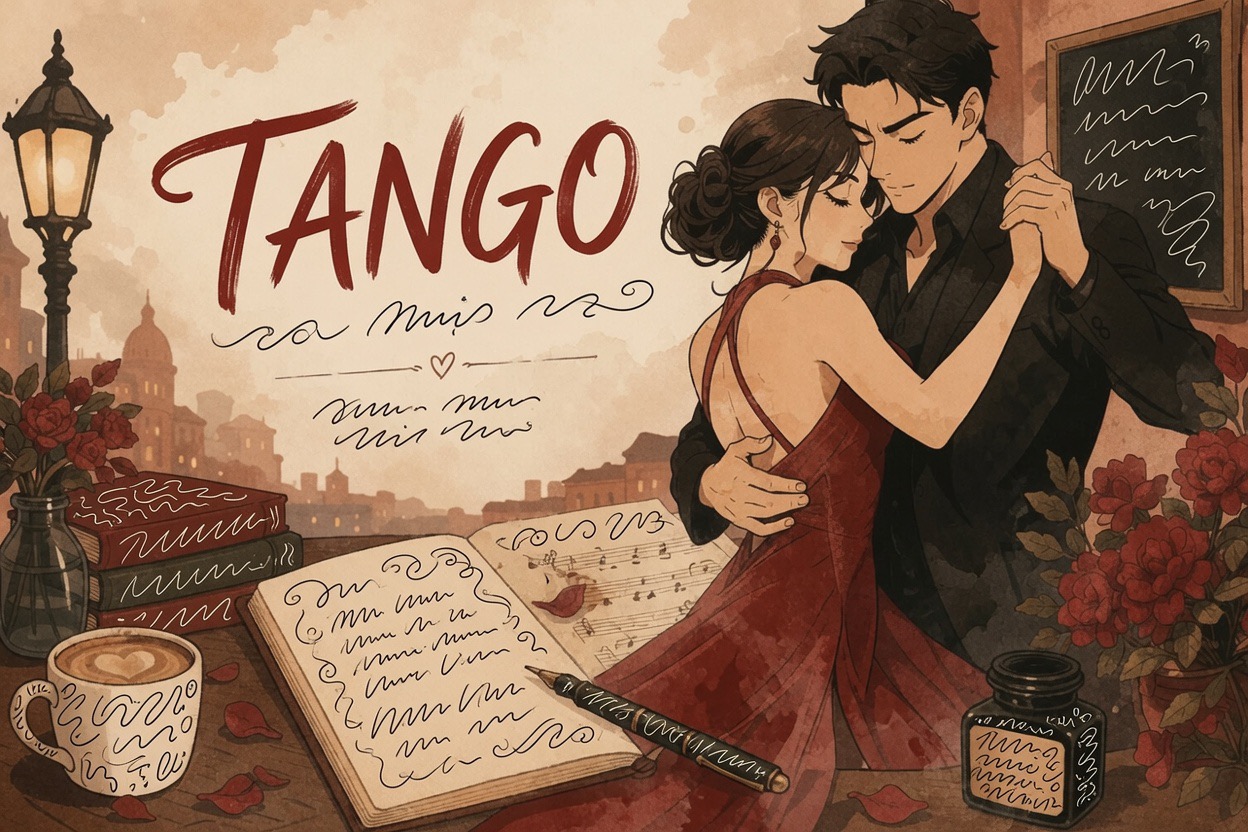
Hinweis: Die Bilder in diesem Beitrag wurden mit KI erstellt.
Instagram unterstützt keine direkten Web-Shares — bitte Link kopieren und in Story oder DM einfügen.
Kommentare
Lädt…