29. Juli 2026
Tango After the Boom: A Search for Traces
Pekka
You are reading an automatic translation. Original language: Deutsch.
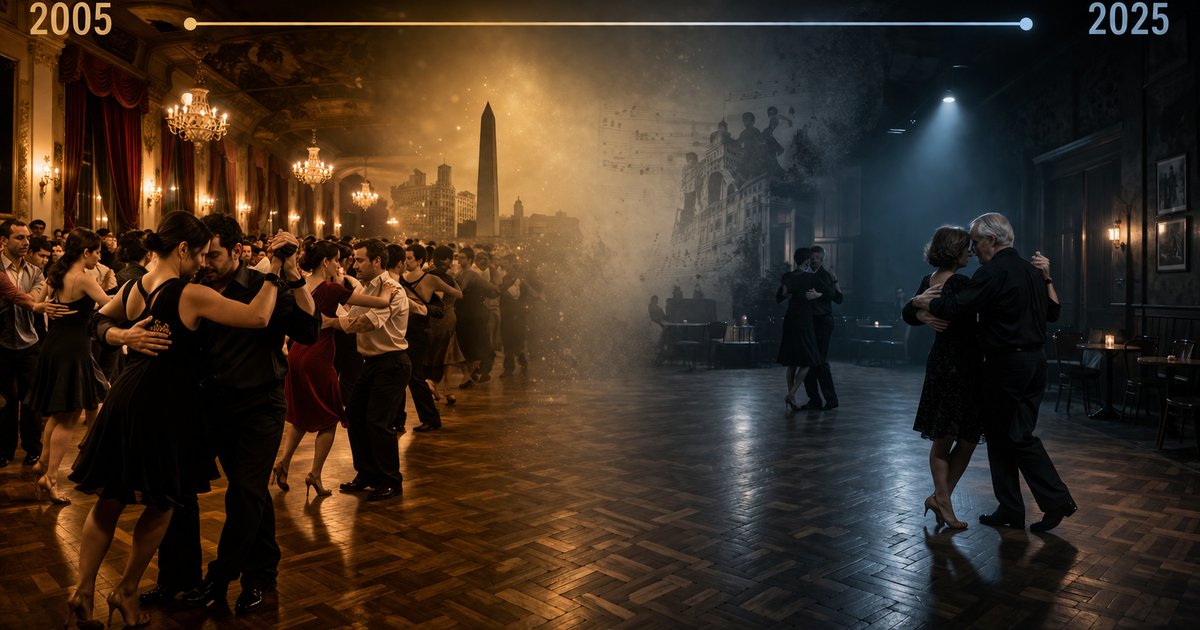
When I think back to my first years of Tango, it feels like a different world. In 2001, Tango was everywhere. Of course, it didn't compete with popular hobbies like football or skiing, but people knew about it, or had friends who danced it. Newspapers regularly published articles about the magic of this dance, about Buenos Aires, Piazzolla, and the newer electronic Tango music. If you got curious, you went to a Milonga or a beginner's class. Just like I did back then with a friend (even though we actually wanted to go to a Salsa class).
What was special back then was the “Tango Nuevo,” which had just emerged: a new way of understanding the dance, breaking it down into its individual components, and reassembling them as desired. New movements emerged, whose biomechanics we analyzed, and based on which we then experimented with the consequences for leading and following. There was this special identity… we were all researchers. There was a mood of awakening and discovery that had something playful about it. It was about how mass moves in space and time, about vectors and anatomy. For example, we tested how a step could be naturally interrupted to become something completely different. For many, that was precisely the entry point: access through the logic of two bodies, through a kind of applied biomechanics that suddenly made it tangible that Tango is not a dusty ballroom dance, but a learnable operating system for human anatomy in motion.
This cultural movement captivated a large number of new, young dancers, grew throughout the 2000s, and greatly helped to spread it. It was probably also not uninvolved in UNESCO's decision in 2009 to recognize Rio de la Plata Tango as a World Heritage Site.
At the same time, there was also a large number of Tangueros who felt unrepresented by the new culture and resisted it. According to the accusation—and increasingly the judgment of the home scene in Buenos Aires from the late 2000s—the new, enthusiastic research spirit was accompanied by a lesser aesthetic awareness, hyperactivity on the dance floor, and above all, a lack of awareness for other couples and a lack of musicality. I myself translated an open letter from Tete Rusconi to the European Tango community into German and helped to publish it in forums. That was in spring 2006, and at the time, I didn't realize that this Tanguero was ahead of his time with his critique of modernity. When important figures of Tango Nuevo, such as Chicho Frumboli and Sebastian Arce, publicly turned against the movement they had started, the decline of Tango Nuevo was sealed.
It became part of Tango history and, instead of being avant-garde, was now a frowned-upon way of dancing. The “post-nuevo” era defined itself by a return to supposedly forgotten traditions. As a Tango dancer in Europe, I noticed little of the cultural change at the time—it only gradually took effect. It must always be remembered that we live here on the periphery of Tango, whose vital center is in Buenos Aires. Developments from the center to the periphery often take many years. Throughout the 2010s, Tango lost some of its wildness from the 2000s, and dancing became more exclusively focused on the beautiful music of the golden 1940s and less on electronic and pop music.
So, the constant new discoveries of new steps no longer continued. And a result of this dissipated vitality was that less was written and published about Tango. There was less new to report. The Tango Nuevo story had happened, been told, and was over. As a result, Tango received less natural publicity. Its popularity declined again, even though students were still there initially. But from the late 2010s, it also became apparent in dance schools in many places that more marketing had to be invested for a full beginner's course—or one had to continue with smaller classes.
Tango Nuevo was not only a magnet for new dancers but also a guide. We wanted to dance like Chicho, Lucia, Eugenia, the Naveiras. Its decline opened the field for new trends. The increasing importance of the “Mundial,” the world championships, naturally filled this vacuum. This institution is inevitably compelled to make decisions that shape the Tango world aesthetically. By defining what is considered more or less “beautiful,” it determines the desires of dancers, organizers, and teachers. Naturally, this aesthetic was oriented towards a neighborhood style from the north of the city, Villa Urquiza. It embodies maximum elegance and is a little closer to stage Tango than other, tighter dance styles.
With the demise of Tango Nuevo and the rise of the Mundial, the defining aesthetic in Tango changed from arms waving to express relaxation to an embrace that expresses constancy through a more consistent relationship in the upper bodies. The complex steps were retained but polished. The disorientation and the new zeitgeist created a situation where Tango no longer clearly conveyed the same message as a unified culture. The conflict between the trends of the 2000s vs. the 2010s changed the overall image of the dance. The new, more conservative message of “back to the roots” certainly also had something stricter and sometimes less attractive about it and did not always help to attract new students.
One thing is clear: even before the pandemic, Tango in Europe was on the decline. It no longer offered that very specific identity of discovering biomechanics and the invitation to creativity in this field. Due to Corona, social distancing, working from home, and other deep culture-changing developments such as the steadily growing turn to the digital in a world of social media and AI, the majority of an entire Tango “generation” is now additionally missing.
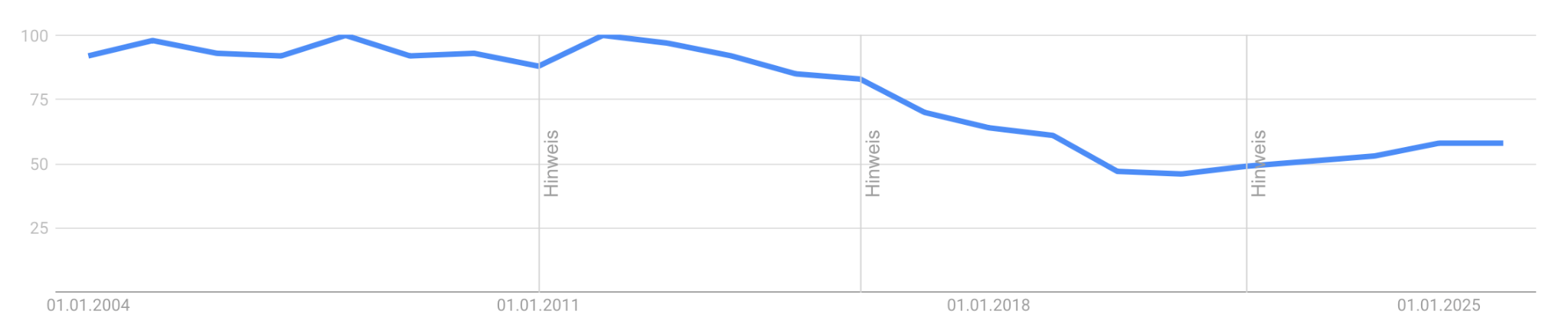
Search Interest “Tango” (Google Trends, 2004–2025)
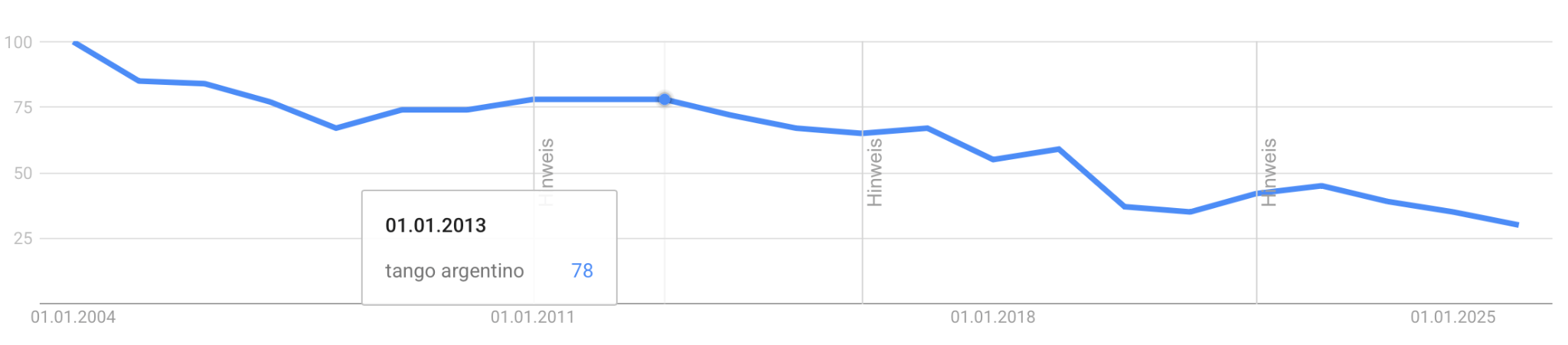
Search Interest “Tango Argentino” (Google Trends, 2004–2025)
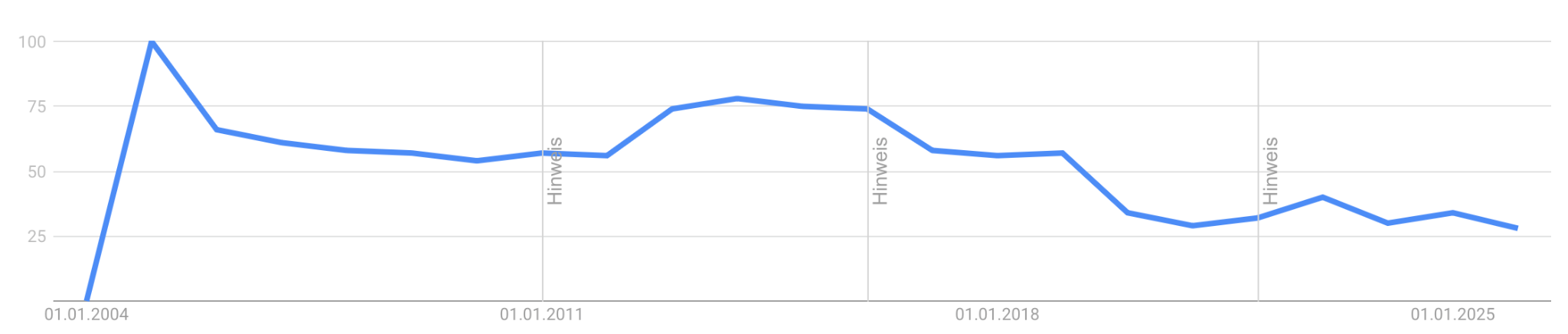
Search Interest “Tango Münster” (Google Trends, 2004–2025)
Regardless of the causes, the result is Tango scenes that are significantly older compared to the 2000s, with partly very experienced dancers—without new recruits. The picture is not the same everywhere. In Southern and Eastern Europe, for example in Warsaw or Belgrade, there are examples of successful and growing campaigns that bring new members with great potential to the dance. Fortunately, even in Germany, there are small shoots of these newer Tango movements that adapt to new circumstances, necessities, technologies, and market structures.
Münster is not one of them, and it is up to us to find ways to change that.
Source texts for further reading: The Chicho Interview (El Tangauta, 2009) · Teté’s Open Letter (2006)
Hinweis: Die Bilder in diesem Beitrag wurden mit KI erstellt.
Instagram unterstützt keine direkten Web-Shares — bitte Link kopieren und in Story oder DM einfügen.
Kommentare
Lädt…